Dieser Beitrag ist auch verfügbar auf:
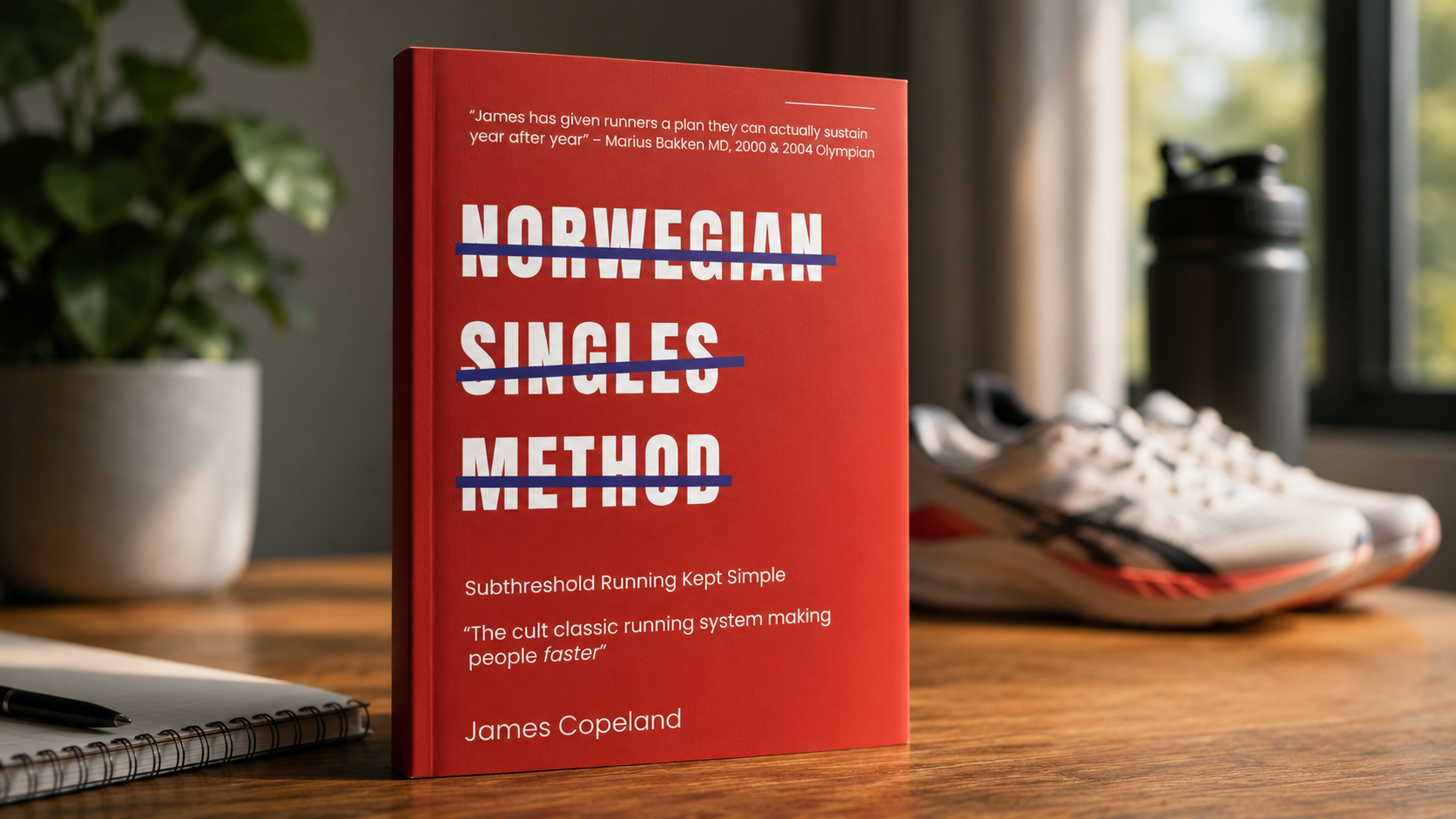
The Norwegian Singles Method wasn’t invented by a world-famous coach — it grew out of a running forum. After 410 pages and more than 8,000 replies, it was time for a book that pulls it all together.
Note: I purchased the book “Norwegian Singles Method” myself. This article contains affiliate links to Amazon.
A Forum Thread That Got Too Big
How do you turn a thread like that into a book? Who should be the author when the whole thing is a community project? Someone just has to sit down, open Google Docs, and write it all out. No publisher, no editor, no advance.
In the end, it was James Copeland — known online as sirpoc84 — who wrote “Norwegian Singles Method: Subthreshold Running Kept Simple” and played a central role in shaping the method itself. He’s upfront about it in the foreword: “I have not invented anything new. All I have done is explain why I think a well-established cycling training technique also works for running.”
| Preview | Product | Price | |
|---|---|---|---|

|
Norwegian Singles Method: Subthreshold Running Kept Simple |
19,53 EUR |
Bei Amazon kaufen |
The book came out at the end of 2025 and — given how it and the method were born — is quite unlike anything else on the running book market.
Where Did This Come From? — A Family Tree
To understand what the Norwegian Singles Method actually is, it helps to trace where it came from. And it doesn’t start in running — it starts in time trial cycling.
Andrew Coggan coined the concept of the “Sweet Spot” there — an intensity zone just below Functional Threshold Power (FTP) that delivers a strong training stimulus while still allowing comparatively fast recovery. Sirpoc had been a passionate time trialist in a previous life, power meters and interval protocols included.
When he started running, he simply brought that mindset along. The key question was: is there an equivalent intensity zone in running — and can it be used in a structured way?
Marius Bakken knows this zone too. His Norwegian Method, the double threshold sessions, the lactate-guided training — all of it targets the same physiological sweet spot. Sirpoc had been reading Bakken’s texts at 1am and recognized the connection to cycling logic. That doesn’t make Bakken the father of NSM — but he’s certainly one of its godfathers, which is why he wrote the foreword to the book.
What makes Bakken’s Norwegian Method tick is covered in detail in its own article here on harlerunner.de → The Norwegian Method Applied — Marius Bakken’s Running Book Reviewed
Sirpoc Is the Class Rep — Not the Inventor
Many runners contributed to the LetsRun thread that started it all — sharing knowledge, insights, and data — and they were equally important for the book project. “Hard2find” — still anonymous, one of the most prolific minds in the community — supplied tables, spreadsheets, and data analysis. Nathaniel Burness (now known for his project modeltherun.com) built the graphics and visualizations for the book. Asha Zimmerman MD handled the editing — and admits in the book with dry humor: “In reality, my job was to translate the manuscript into American English.”
Sirpoc didn’t actually want to write the book. He didn’t want to make money from it either. He apparently turned down offers to that effect. The book exists simply because the material outgrew forum posts and because the community wanted it. That’s all.
The name? “Norwegian Singles Method” — sirpoc himself says it’s misleading. It comes from the title of the original thread “Modifying the Norwegian approach to lower mileage” — even if what emerged from it became something quite its own. Beyond the thread, the community has kept building: a Google Site (sites.google.com/view/sub-threshold), a GitHub repo (bart6114/norwegian-singles), and a dedicated LacTrace calculator for pace calibration, among others.
What the Book Teaches — The Method
Right then. What exactly is the Norwegian Singles Method?
75/25 and the Subthreshold Sweet Spot
The core idea is simple: 75% of weekly running volume should be genuine easy runs — with a heart rate ceiling of 70% HRmax. The remaining 25% is split across three quality sessions per week, consistently in the subthreshold zone.
Subthreshold here means: just below the second lactate threshold (LT₂), but never at or above it. Too easy, and the training stimulus disappears. Too hard, and recovery between sessions collapses — and the whole system falls apart. Because the system is designed to allow a “standard week” to be repeated indefinitely.
The Three Formats — and Why They’re Called What They’re Called
Sirpoc didn’t design the quality session formats at a desk. He was his own lab rabbit — measuring lactate values at various paces, rep lengths, and recovery durations: 10k pace gave 4.9 mmol/L — too high. 15k pace gave ~2.5 mmol/L — Sweet Spot. Three formats emerged from this work, designed to keep most runners reproducibly in the target lactate range of 2.3–3.0 mmol/L.
Which means: the Norwegian Singles Method, just like Bakken’s Norwegian Method, is rooted in lactate measurements — except sirpoc has done the legwork of converting those into pace ranges. NSM can therefore be used without running your own lactate tests.
| Format | Pace | Rest |
|---|---|---|
| 3 minutes | ~12–15k race pace | 60 sec |
| 6 minutes | ~20k race pace | 60–90 sec |
| 10 minutes | ~25–30k race pace | 90–120 sec |
For a concrete 5k time of 20 minutes, the 6-minute rep pace works out to around 4:20/km — well below half marathon race pace, but clearly faster than a genuine easy run. The full tables are in the book, of course.
Calibration: Friel LTHR Test
To get a first reference point before starting out, one approach is the Friel Lactate Threshold HR Test: a 30-minute time trial, with the average HR (or pace) of the final 20 minutes giving you your LTHR. This number acts as a guardrail — heart rate during quality sessions should not remain consistently above it.
Sample Week (5–5.5 Hours)
| Day | Session |
|---|---|
| Monday | 40 min easy |
| Tuesday | 3×10 min (50 min incl. WU/CD) |
| Wednesday | 35–40 min easy |
| Thursday | 5×6 min (45 min incl. WU/CD) |
| Friday | 35–40 min easy |
| Saturday | 8×3 min (50 min incl. WU/CD) |
| Sunday | 70 min easy |
Worth emphasizing again: the week contains one speedwork session, no strides, and no strength training — at least not in sirpoc’s own practice. The reasoning: anything added outside this framework risks tipping the fatigue balance of the quality sessions, and that’s where the system breaks at its core. The goal is keeping load and recovery in genuine equilibrium.
intervals.icu is, incidentally, James Copeland’s natural habitat for this method too — load tracking, CTL/ATL/TSB, workout calendar, all free, all compatible.
A Personal Note
I’m currently testing the method myself — though with two quality sessions per week instead of three. Since I want to train by power, I need to calibrate the intensities for my own profile, which means going through lactate testing again (with the Lactate Scout Sport). A dedicated article will follow once I’ve collected enough data and experience… :)
NSM vs. Bakken: Siblings, Not a Copy
Bakken’s Norwegian Method is designed for ambitious to elite runners: double threshold sessions, a lactate meter as the primary steering tool, a training volume that simply isn’t realistic for people with regular jobs. Bakken writes in the NSM foreword himself: “It is very intense and demanding. It was never intended for parents who juggle work and family.”
Alongside Bakken’s own efforts to adapt the Norwegian Method for lower volume, NSM offers what looks like a simpler solution: singles instead of doubles, pace instead of lactate measurement, three quality sessions instead of six. Both systems share the core idea — subthreshold is the sweet spot. But the demands are fundamentally different.
Bakken writing the foreword is more than a friendly gesture. It’s a substantive endorsement: “James has simplified without diluting.” That’s the hardest thing to pull off in any method adaptation — and according to Bakken, it works here.
What the Community Has Built on Top
The LetsRun thread and the book are certainly the foundation of the method. But the community has kept building — and has sometimes run into walls, which is at least equally instructive.
Power instead of pace (Stryd): Sirpoc tested this early on — ~78% FTP as an easy cap, the pace curve flattens, the HR curve stabilizes. For easy runs, power-based control works well; for quality sessions, pace remains the more reliable reference (in his view). I’m honestly not so sure about that, and plan to test it for myself.
Pfitz→NSM hybrid: Well documented on LetsRun (page 228). Pfitz 18/70 from January to May, then NSM for the rest of the year. 5k progression from 19:00 to 17:25 — with significantly less time commitment than Pfitz alone.
Triathlon: Karen Parnell (ChiliTri) has applied NSM to age-group triathletes and shows how the method can be integrated into a multi-sport framework.
And the limits? On Outside Run, for example, there are also dissenting voices: a 42-year-old ultrarunner ran the Bulldog Ultra 25K twenty minutes slower than four years prior, despite full commitment to NSM. The method is methodologically cleanest for distances from 5k to half marathon — for ultras, the specificity just isn’t there. The book does say this itself, just a little quietly ;)
My Take:
The project and the book are genuinely exciting!
No publisher, no marketing pressure, no promise of a personal best in twelve weeks. A 41-year-old teacher writes down in a Google Doc what a community collectively figured out. Sometimes it’s that simple.
What’s methodologically compelling above all is the approach to fatigue management. Anyone who’s tried to run three genuine quality sessions per week properly knows how easily the grey zone between easy and subthreshold quietly undermines the sessions — and how hard it is to resist the urge to just add a little more on top.
What remains open: I’m still in the middle of the experiment. Whether the calibrated pace tables work for my profile or whether individual adjustments would make sense — that’s still to be seen.
| Preview | Product | Price | |
|---|---|---|---|
|
|
Norwegian Singles Method: Subthreshold Running Kept Simple |
19,53 EUR |
Bei Amazon kaufen |
The book is available on Amazon as a paperback and e-book. For anyone who’d rather dip a toe in first: the LetsRun thread and the Google Site are a good, free starting point.

Autor und Betreiber von Harlerunner.de. Läufer seit mehr als zehn Jahren, über 100 Wettkämpfe von 5 km bis Halbmarathon im Gepäck, bisher mehr als 500 Produkte getestet. Kein Labortest — alles kommt aus dem echten Training in und um Coesfeld. Was du hier liest, hat er selbst an den Füßen, am Körper, am Handgelenk oder im Ohr gehabt.
Author and owner of Harlerunner.de. A runner for over ten years, with more than 100 races under his belt – ranging from 5 km to half-marathons – and having tested over 500 products to date. No lab tests – everything is based on real-world training in and around Coesfeld. Everything you read here is something he has personally worn on his feet, on his body, on his wrist or in his ear.